
 EN
EN



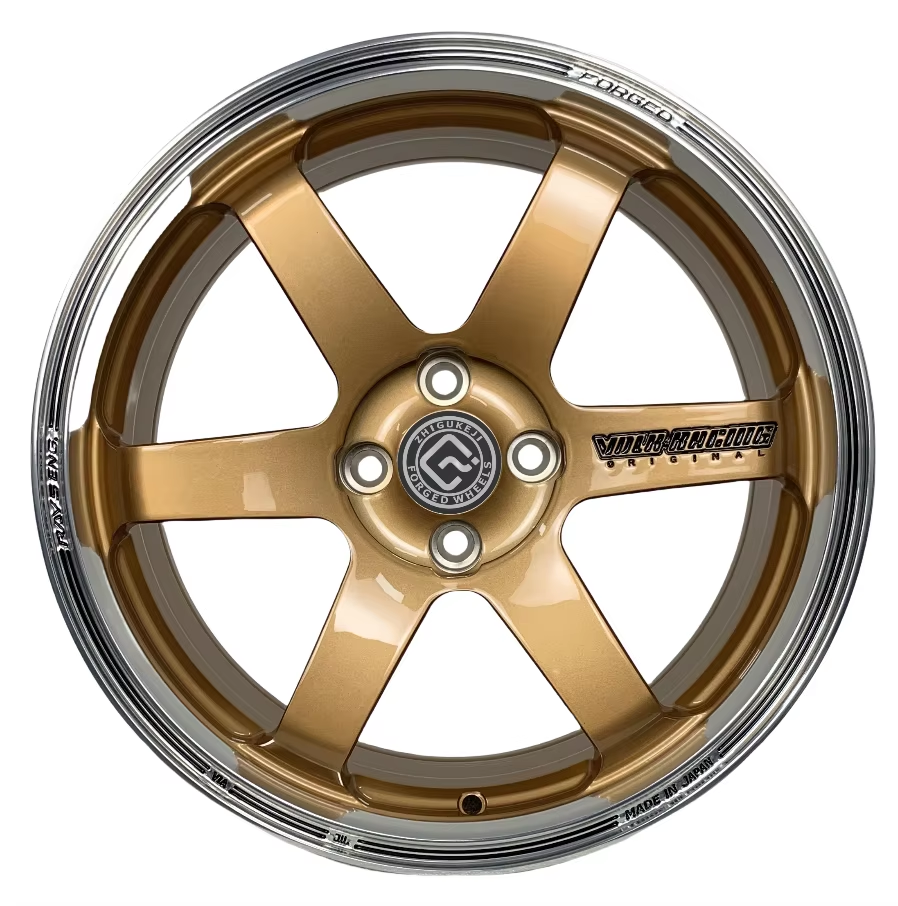
How Material Science Enables Extreme Lightweight Design in Racing Wheels
Material science breakthroughs allow racing wheels to achieve unprecedented strength-to-weight ratios. Advanced composites and high-performance alloys minimize rotational mass while preserving structural integrity under extreme track conditions—directly enhancing acceleration, braking response, suspension fidelity, and driver feedback.
Carbon Fiber: Lowest Rotational Mass with Track-Validated Stiffness
Carbon fiber composites offer significant weight savings for race wheels, making them popular among serious competitors. These materials have density figures under 1.6 grams per cubic centimeter, which means they can reduce rotational mass by around 40 percent compared to similar aluminum setups. The lighter weight makes a real difference on track - cars accelerate quicker off corners, stop shorter, and handle bumps better because the suspension reacts faster to road conditions. What makes carbon fiber so special is how its properties vary depending on fiber orientation. Engineers can lay down the fibers in ways that stiffen up areas where cornering forces hit hardest, yet still keep enough give to absorb impacts from rough surfaces. For long races, modern resin systems like epoxy-phenolic blends hold everything together even when temperatures climb past 150 degrees Celsius, so there's no risk of layers separating after hours of hard driving.
Forged Magnesium: The Gold Standard for High-Strength, Ultra-Light Racing Wheels
Magnesium alloy wheels forged under extreme conditions have become the gold standard in high performance racing circles, particularly in Formula 1 circuits, World Endurance Championship races, and GT3 competitions. These wheels weigh around 33 percent less than their aluminum counterparts while still offering superior stiffness relative to their weight. The result? Better handling characteristics with improved vibration absorption and faster heat dissipation during track sessions. During the forging process, manufacturers apply pressures reaching approximately 10,000 tons which compresses any internal voids and creates aligned grain structures. This produces material strength ratings above 200 MPa, making them capable of withstanding intense cornering forces without permanent shape changes. Modern alloy variants such as ZK60 and WE43 maintain their structural integrity through numerous temperature fluctuations from minus 40 degrees Celsius all the way up to 300 degrees Celsius. Early magnesium wheels suffered from microscopic cracks forming over time, but these newer versions avoid that problem entirely. When subjected to stresses beyond what engineers anticipate, these alloys deform gradually instead of snapping suddenly, giving drivers those extra precious seconds needed to recover control in emergency situations.
Strength Under Real-World Track Loads: Structural Integrity and Safety Margins
Racing wheels are pushed right to their material limits during competition. These components face incredible forces all at once - they need to withstand sideways acceleration forces over 1g, take punishment from curb strikes and road imperfections, and handle extreme temperature changes of around 300 degrees Celsius between hot brake contact areas and cooler outer sections. The wheel doesn't just stay intact under these conditions; it must maintain its shape, avoid cracks forming, and keep proper clamp force on the tire. When engineers test these wheels, they look beyond simple strength measurements. What matters most is how well the material holds up over repeated stress cycles, stays stable when heated, and fails in ways that can be predicted and managed safely.
Withstanding >1g Lateral Forces and Thermal Cycling During Extended Sessions
When vehicles take corners at speed, lateral forces create significant shear stress on wheel spokes and rim beds. At the same time, braking generates heat that makes different parts expand at varying rates. This happens especially between metal alloy hubs and carbon fiber rims, sometimes even inside multi-layered magnesium components. Materials that don't expand much when heated, like particular types of magnesium alloys with around 26 x 10^-6 per degree Celsius expansion rate, or unidirectional carbon fibers which expand less than 1 x 10^-6 per degree along their length, help maintain wheel geometry and keep bolts properly tensioned during repeated heating cycles. Most top bike component makers now rely on computer simulations called finite element analysis (FEA). These are fine-tuned using actual road test data including measurements from tiny strain gauges mounted right on the wheels themselves. This allows engineers to predict how wheels will handle both mechanical stress and temperature changes long before they ever build a physical prototype in the workshop.
Fatigue Life, Yield Strength, and Minimum Safety Factor (FoS ≥ 2.5) for Racing Wheels
Three interdependent metrics define racing wheel reliability:
- Fatigue life: Minimum 100,000 stress cycles at peak operational loads (validated via accelerated testing replicating 24-hour endurance conditions)
- Yield strength: ≥350 MPa for critical zones (rim flange, spoke root, hub interface), ensuring no permanent deformation under transient overloads
- Safety factor: A minimum FoS of 2.5 is mandated by FIA Appendix J and SAE J2530 for all load-bearing components—accounting for curbing impacts, debris strikes, and manufacturing variability
This margin ensures theoretical failure thresholds exceed real-world maximum loads by at least 150%, with validated test data showing top-tier forged and RTM wheels consistently exceed requirements by 250%.
Manufacturing Processes That Maximize Strength-to-Weight Ratio in Racing Wheels
The choice of manufacturing method determines how fully a material’s inherent properties are realized. Each technique shapes microstructure, density, and consistency—directly influencing strength-to-weight ratio, repeatability, and long-term durability.
Flow Forming vs. Forging vs. Resin Transfer Molding: Impact on Density and Consistency
Flow forming begins with a cast aluminum blank, then uses rotating rollers to stretch and thin the rim barrel under high pressure. This refines grain structure radially, increasing tensile strength by ~15% while reducing weight 15–20% versus conventional casting—ideal for cost-sensitive, high-volume applications where moderate FoS margins suffice.
Forging compresses heated billets under extreme pressure (up to 10,000 tons), eliminating internal voids and producing near-full-density parts with aligned grain flow. This yields the highest impact resistance and minimal variation in mechanical properties—making it the preferred method for magnesium and high-strength aluminum alloys used in professional motorsport.
Resin Transfer Molding (RTM) injects catalyzed resin into precision carbon fiber preforms under vacuum and controlled heat/pressure. It achieves near-theoretical fiber volume fractions (>60%) and void content <0.5%, resulting in the highest stiffness-to-weight ratios among production racing wheels—±0.5% dimensional tolerance and consistent layup control enable repeatable performance lap after lap.
The optimal process depends on application priorities: flow forming balances cost and weight; forging maximizes metallic durability; RTM unlocks carbon’s full structural potential—always anchored by FoS ≥ 2.5 and validated against FIA or SAE standards.
Selecting the Right Racing Wheels: Matching Material, Process, and Application
Choosing the right racing wheel demands a systems-level approach—not just selecting a lightweight option, but matching material behavior, manufacturing fidelity, and real-world track demands.
- High-speed circuits (e.g., Monza, Spa) benefit most from carbon fiber RTM wheels: their ultra-low rotational inertia delivers measurable gains in throttle response and braking modulation, while advanced resins ensure thermal resilience across long stints.
- Endurance racing (e.g., Le Mans, Nürburgring 24H) favors forged magnesium: superior thermal conductivity dissipates brake heat faster than aluminum, and its ductile failure mode provides essential safety redundancy during multi-driver, multi-condition sessions.
- Drag racing prioritizes torque transmission and axial rigidity—where forged one-piece aluminum or hybrid carbon/magnesium constructions excel in minimizing twist under launch loads.
- Track-day or club racing may favor flow-formed aluminum for its balance of performance, serviceability, and value—provided FoS and load ratings meet SAE J2530 or equivalent certification.
Always verify compatibility: bolt pattern, center bore, offset, and dynamic load rating must align with both vehicle specifications and sanctioning body requirements. Compromising on fitment or certification risks catastrophic structural failure—even with premium materials and processes.
Frequently Asked Questions (FAQ)
What makes carbon fiber ideal for racing wheels?
Carbon fiber is ideal for racing wheels due to its lightweight properties and ability to be customized for stiffness in specific areas, offering significant weight savings while maintaining strength and stability on the track.
Why is magnesium used in high-performance racing wheels?
Magnesium is used in high-performance racing wheels because it offers superior stiffness relative to its weight, better vibration absorption, and faster heat dissipation, making it ideal for competitive racing environments.
What is the significance of a Safety Factor (FoS) in racing wheels?
The Safety Factor (FoS) in racing wheels is crucial as it ensures components can handle loads beyond expected maximum stress by a designated percentage. A minimum FoS of 2.5 is required to account for unpredictable forces during racing.
How do manufacturing methods affect the performance of racing wheels?
Different manufacturing methods like flow forming, forging, and resin transfer molding influence the microstructure, density, and consistency of racing wheels, directly affecting their strength-to-weight ratios and overall performance on the track.
Table of Contents
- How Material Science Enables Extreme Lightweight Design in Racing Wheels
- Strength Under Real-World Track Loads: Structural Integrity and Safety Margins
- Manufacturing Processes That Maximize Strength-to-Weight Ratio in Racing Wheels
- Selecting the Right Racing Wheels: Matching Material, Process, and Application
- Frequently Asked Questions (FAQ)